
India's exports are becoming less vulnerable to changes in world demand and exchange rates, according to a publication titled 'Re-examining Narratives: A Collection of Essays', penned by chief economic advisor (CEA) V Anantha Nageswaran and his team. The publication pointed out that this conclusion has been drawn from the fact that there has been a decrease in the income elasticity of exports to 3.44 during 2009-2022, from 5.67 during 1991-2008, and in the inverse price elasticity of exports to 0.4 from 2.7. While a decline in elasticities is favourable in the presence of downside risks such as a decline in global demand and an appreciation of exchange rates, it may not be beneficial during boom periods.

Notwithstanding the robust turnaround in the financial performance for the June quarter (Q1FY24), stocks of state-run oil marketing companies have been in a downtrend in the last month. The fall comes on a rise in crude oil prices that have surged to a 7-month high of $88 a barrel. A busy political calendar in the months ahead that may see the government keep a lid on auto fuel prices is also a dampener, analysts said. Shares of Hindustan Petroleum (HPCL), Bharat Petroleum (BPCL) and Indian Oil (IOC) have shed 9-11 per cent since their respective earnings announcement between July 26 to August 4.


The government can issue recapitalisation bonds, or the RBI's huge reserves of over $127 can also be dipped into to help the state-owned bank's recapitalisation needs.

Corporate earnings got a big boost from the fall in commodity and energy prices in July-September 2023 (Q2FY24) despite a slowdown in revenue growth during the quarter. The combined net profits of 3,123 firms that have declared their results so far were up 38 per cent year-on-year (Y-o-Y) to Rs 3.07 trillion in Q2FY24, up from Rs 2.24 trillion a year ago. Earnings were, however, down 3.5 per cent on a sequential basis from Rs 3.18 trillion in April-June (Q1) FY24.

P&G Hygiene and Healthcare's June quarter numbers were better than Street estimates, led by strong sales and robust margins. The company, which owns leading consumer brands like Whisper, Vicks and Old Spice, posted a 12.6 per cent year-on-year (Y-o-Y) growth in sales at Rs 852.5 crore during the quarter. The double digit sales growth, led by expansion of its distribution reach, reverses a sluggish sales graph with three of the last four quarters reporting a fall in sales.

The Colgate-Palmolive (India) stock gained 2.3 per cent in trade on Friday, and ended at Rs 2,079 per share. This was on the back of a robust operating performance in the July-September quarter of 2023-24 (Q2FY24) and expectations of gradual sales recovery going ahead. While the stock is up 44 per cent from its lows in January this year, further gains will depend on its ability to sustain higher growth rates.

Manchester City celebrated their Premier League title on Sunday, beating Chelsea 1-0 with an early goal by Julian Alvarez in the team's home finale at a sun-drenched Etihad Stadium.

The argument that India is going towards a 'Hindu rate of growth' is "ill-conceived, biased and pre-mature" when weighed against the respective data on savings and investments, said SBI Research in its Ecowrap report. The term Hindu rate of growth was coined by economist Raj Krishna in 1978, which denoted the economic growth of about 3.5-4.0 per cent in terms of GDP during 1947-1980. "India's quarterly sequential Y-o-Y GDP growth has been in a declining trend in FY23.

'We are cautious only on sub-sectors that have seen massive melt-up during the past six months.'

The net debt of top eight realty firms fell 43 per cent to Rs 23,000 crore last fiscal, from around Rs 40,000 crore in 2019-20, as their cash flow improved on strong housing sales, according to Anarock. Real estate consultant Anarock noted that the unfettered demand for housing across the country has enabled the country's leading large and listed developers to reduce their debt. Anarock analysed financial performances of the top eight developers engaged in the development of residential real estate.

The headline for corporate profit growth has been very encouraging in the July-September quarter (Q2) of 2023-24 (FY24), with the combined net profit of listed companies up by 38 per cent year-on-year. However, the earnings distribution has been very lopsided, with most of the growth coming from public-sector oil-marketing companies (OMCs), banks, non-bank lenders, automobile (auto) companies, and cement producers. By comparison, companies from information technology services, fast-moving consumer goods (FMCG), retail, and consumer durables were disappointed, experiencing a sharp slowdown in net sales growth and a relatively muted increase in reported net profit.
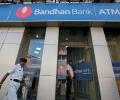
Bandhan Bank has declared disappointing results for the first quarter of the 2023-24 financial year (Q1FY24). While the market has been braced for known issues around microfinance exposures in West Bengal and Assam, there is higher stress in the portfolio. This means higher credit costs and poorer asset quality, leading to target downgrades by analysts.

7 states account for over 80 per cent of the total direct tax collections by the Union government.

A summary of Saturday's action in the Premier League.

Rennes denied late Europa League equaliser due to little-known rule

Most analysts have downgraded the stock of SBI Cards and Payments (SBI Card) as the credit card issuer posted weak results during the December quarter (Q3) of financial year 2023-24 (FY24). The sub-par show, analysts said, was for the eighth straight quarter. With this, they have slashed their earnings estimates by as much as 20 per cent over FY24-26 amid near-term pressure points in the company's growth outlook.

Now that the economy is growing at a higher-than-expected rate, it is time to accelerate the pace of fiscal consolidation, and the Budget could be a good starting point, argues Rajesh Kumar.

An acute drug shortage in the US and stable pricing along with product launches are likely to boost revenues of India's pharmaceutical companies during the first quarter of this financial year, analysts said. Most brokerages estimate a top line growth of around 14-15 per cent, with earnings before interest, taxes, depreciation, and amortisation (Ebitda) growth of 24-30 per cent for Q1 of FY24. Hospitals are, however, likely to report lower occupancy rates, and diagnostics companies may witness an impact from delayed monsoon.

India Inc's net profit as a percentage of the country's gross domestic product (GDP) is just shy of reaching 5 per cent, bolstered by strong earnings growth in the second quarter of 2023-24. Analysts interpret this as an indication that a corporate profit upcycle is in progress, with projections suggesting that this share could exceed 8 per cent within the next five years, driven by bullish earnings growth expectations. "We believe we are only halfway through a profit cycle, with the profit share in GDP rising from a low of 2 per cent in 2020 to about 5 per cent currently, and likely heading to 8 per cent in the coming four to five years. "This implies about 20 per cent compounding of earnings growth. "Underscoring this forecast is the start of a new private capex cycle, under-geared balance sheets, a healthy banking system, lower corporate tax rates, improving terms of trade, and structural consumption demand outlook albeit somewhat offset by likely consolidation in government deficit," said Ridham Desai, managing director, head of research, Morgan Stanley India in a note.

Tyre stocks have been on a tear over the past six months, with average returns exceeding 45 per cent. Except for Apollo Tyres, which has seen a slight correction in the last month and a half, limiting its gains to 16 per cent, listed peers such as MRF, CEAT Tyres (formerly Cavi Elettrici e Affini Torino), and JK Tyre & Industries have delivered returns exceeding 30 per cent during this period. Production-related constraints and sluggish demand in Europe, where sales are expected to remain flat, coupled with high valuations, have contributed to Apollo Tyres' underperformance. The tyre sector's gains can be attributed to robust growth trends driven by the replacement market, which constitutes more than two-thirds of sales.

Following a strong performance in the 2022-23 January-March quarter, publicly listed paint industry giants displayed a mixed performance in the 2023-24 (FY24) April-June quarter. While Berger Paints India outperformed its peers and reported results in line with expectations, market leader Asian Paints and Kansai Nerolac Paints fell slightly short of expectations.

The Bombay high court on Sunday dismissed a public interest litigation (PIL) filed by four students against the Maharashtra government's decision declaring a public holiday on January 22, on the occasion of the Ram temple consecration ceremony in Ayodhya.

Hindustan Unilever Ltd on Friday reported a 1.08 per cent increase in consolidated net profit at Rs 2,508 crore in the third quarter ended December 2023. The company had posted a consolidated net profit of Rs 2,481 crore in the same quarter last fiscal, Hindustan Unilever Ltd (HUL) said in a regulatory filing. Its revenue from sales of products was marginally down to Rs 15,259 crore during the quarter.

A summary of Sunday's action in the Premier League.

Losers included Bharti Airtel, SBI, Wipro, Vedanta, Maruti Suzuki, ICICI Bank, Axis Bank and Reliance Industries, falling up to 2.18 per cent.

Notwithstanding concerns about lofty valuations, smallcaps recorded their most significant monthly gain in nearly three years in November. The National Stock Exchange Nifty Smallcap 100 finished the month with a 12 per cent gain, the most since February 2021 when it rose by 12.2 per cent. After declining by 4.1 per cent in the preceding month, the Nifty Midcap 100 rose by 10.4 per cent, the most since July 2022.

All six members of the Reserve Bank of India's (RBI's) monetary policy committee (MPC) expressed caution over food inflation during the December review, while two external members warned about high real interest rates as headline inflation approaches its target of 4 per cent. The central bank continued to maintain the status quo on both the repo rate and the stance in the December monetary policy. India's retail inflation in November rose to 5.5 per cent - its fastest pace in three months - due to higher food prices.

A careful reading of the national income accounts suggests that after a strong recovery from the pandemic, there has been a significant ebbing of dynamism over the last three quarters to more modest levels recently, note Arvind Subramanian and Josh Felman.

Following are comments from economists at leading financial institutions, banks and rating agencies on the interim Budget:

'There is an eminently fertile ground that perpetrators must be finding in our society.'

Titan Company on November 21, became the second Tata group firm to join Rs 3 trillion market capitalisation (market cap) club after its shares hit a new high of Rs 3,400, up nearly 2 per cent on the BSE in Tuesday's intra-day trade. At 12:28 PM; with a market cap of Rs 301,847 crore (Rs 3.02 trillion) Titan stood at number 16th position in overall market cap ranking on the BSE listed companies, the exchange data shows. Titan overtook paint company Asian Paints, which has a market cap of Rs 300,579 crore, data shows.

In the July to September quarter of 2023-24 (Q2FY24), Voltas' revenues grew by 29.7 per cent year-on-year (Y-o-Y), but the adjusted net profit was down by 63 per cent Y-o-Y. The revenues hit Rs 2,290 crore, led by growth in the Unitary Cooling Products segment (up 15.4 per cent Y-o-Y, and in the EMP (Electromechanical project) business (up 66.8 per cent Y-o-Y). The UCP revenue rose to Rs 1,200 crore in Q2FY24, driven by volume growth despite weak consumer spending - the three-year annual growth is 18 per cent.

Images from the English Premier League matches played on Sunday night.

The stock of India's largest agrochemical player - UPL (formerly United Phosphorus) - fell 2.8 per cent in trade. It was among the top losers in the BSE 100 on Tuesday. Weak 2022-23 (FY23) January-March quarter (fourth quarter, or Q4) performance and muted near-term outlook led to the decline. The company reported lacklustre growth in revenue of 4 per cent on the back of a price reduction of 3 per cent and volume growth of 1 per cent.

Margins for the oil refining and retailing sector have moved off their peaks, and the average integrated margins (refining plus marketing) for oil marketing companies (OMCs) have normalised. The ascent in crude oil prices, combined with static retail prices, has depressed marketing margins for diesel and petrol. However, the fall in marketing margins has been offset by increased gross refining margins (GRMs).

'We have a plan to plough back a 'This year in the first half we had profits of more than Rs 31,000 crore.' significant amount of profits this financial year.' 'We have seen this organic plough back of profit is one of best ways to support the equity of the bank.'

Yes Bank, Wipro, Kotak Bank, M&M, Sun Pharma, Maruti, HDFC, Hero MotoCorp, Infosys, TCS, L&T, Bajaj Auto and HUL were among the top gainers, rising up to 6 per cent.

Public-sector banks (PSBs) in Q3FY23 wrote off bad loans worth Rs 29,000 crore, up from Rs 23,000 crore in the same quarter a year ago, as part of a clean-up exercise. According to estimates by rating agency CARE Ratings, the write-offs by PSBs in April-December 2022, at Rs 81,000 crore, were lower than the Rs 90,000 crore in April-December 2021. Sanjay Agarwal, senior director, CARE Ratings, said a lot of it was driven by regulations, and assets that had 100 per cent provision coverage were written off.

The stock of Colgate-Palmolive (India) surged after the company delivered a better than expected operating performance for the March quarter of the 2022-23 financial year (Q4FY23) recently. The stock, however, has given up most of these gains over the last one week as the Street awaits recovery in the core toothpaste segment and sustained recovery in market share. The country's largest listed oral care company posted a gross margin expansion of 100 basis points (bps) on a sequential basis to 66.9 per cent, led by pricing and efficient sourcing.
